
She Told Congress the Museum Doesn't Take Sides. The Tape Says History Is a 'Prime Tool of Social Justice.'
Anthea Hartig runs the Smithsonian's National Museum of American History. A resurfaced 2025 lecture has given a House oversight panel the one thing it lacked: her own definition of the job.
WASHINGTON — On July 21, Anthea Hartig sat before the House Oversight Committee's efficiency subcommittee and told members that the National Museum of American History, which she directs, is nonpartisan and does not take sides in the country's political arguments.
The hearing was titled "Rewriting American History: Examining the Smithsonian's Efforts to Reshape the Past." Rep. Tim Burchett opened it by accusing the institution of ideological capture. Hartig's answer was the institutional one every museum director gives, and on the day it largely held.
This week a recording surfaced of a February 2025 presentation Hartig delivered at UCLA, in which she describes her discipline in different terms: "history as a practice … is for me a prime tool of social justice."
Why the phrase matters more than the gotcha
It would be easy, and lazy, to treat this as a caught-on-tape story. Hartig has not been shown to have lied about a fact. She has been shown to hold a theory of her profession that a large share of the people funding it did not know they were funding.
The two statements are reconcilable in the way academics reconcile them. In that framing, "social justice" is not a partisan platform but the moral purpose of recovering histories that were suppressed — and a museum can pursue it while declining to endorse candidates or bills. That is a coherent position, and it is the position she will argue.
It is not, however, what the average visitor to a federally funded museum understands the word "nonpartisan" to mean. When a curator says history is a tool, the follow-up question is not hostile, it is obvious: a tool for accomplishing what, chosen by whom, and what happens to the parts of the record that don't serve the purpose?
The money is the reason Congress gets to ask
The Smithsonian draws roughly two-thirds of its budget from federal appropriations. That is the whole basis of the oversight claim, and it is a stronger one than the usual culture-war jurisdiction fight.
A private museum may curate from any premise it likes; the market answers. A museum on the National Mall that costs the taxpayer close to a billion dollars a year is a different arrangement. The institution has, for decades, sold Congress on that arrangement by promising to be the nation's attic rather than its editorial page — an argument that only works if the attic is not being sorted according to a thesis.
What the exhibits actually show
Subcommittee staff have been working through a list of exhibit texts and label copy since spring, and the specific complaints are narrower than the rhetoric around them. They concern framing choices: which figures get contextualizing paragraphs and which get plaques, whether founding-era achievement is presented alongside founding-era sin or beneath it, how much of the twentieth-century American story is told as progress and how much as indictment.
Reasonable historians differ on every one of those. That is precisely the argument Hartig's own recording makes unavoidable — because if history is a tool of social justice, then those framing choices are not neutral scholarly judgments. They are the tool being used.
What's next
Burchett's subcommittee has signaled it will request the curatorial guidance documents behind the exhibits at issue, which would move the fight from what a director said at a lecture to what an institution wrote down.
That is where it should have started. The Smithsonian's defenders and its critics have spent a year arguing about tone. The documents will settle whether there was a policy.
Rebecca Hartwell
Staff Writer, Idiocracy News
Comments
No comments yet. Start the conversation.
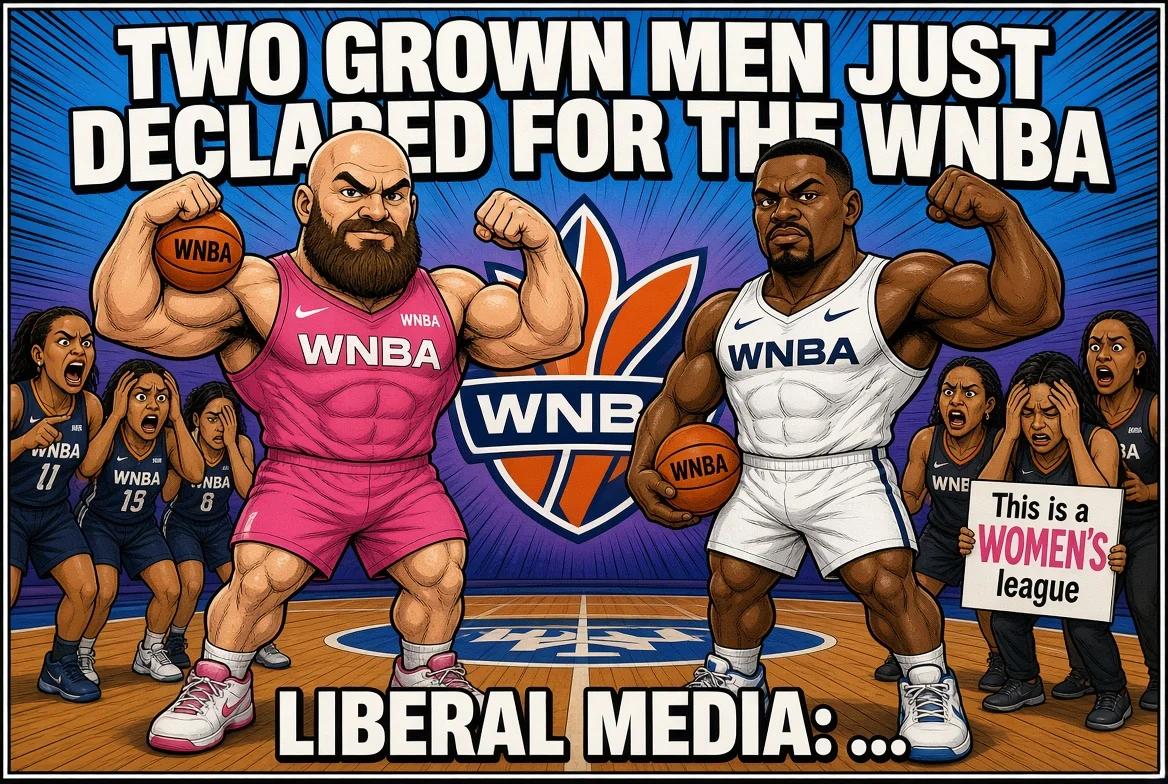
Two Former NBA Players Declared for the WNBA Draft. The Newsrooms That Lecture Us About Inclusion Went Quiet.
The WNBA's eligibility rule says 'only players who are women are eligible.' Across 409 pages, the agreement never defines the term — and two retired men have now built their entire argument on that gap.
The Daily Brief
Get the stories the networks skip
One email. The headlines that matter, with no corporate filter. Unsubscribe in a click.


Comments are moderated. Be civil, no spam, no links to junk.