


“Europe is literally being flooded with cocaine,” Vaz told Fox News. “Criminal organizations … acquire the drugs in Latin America, and then the price at which they place it in the markets … there’s a big profit margin here.”
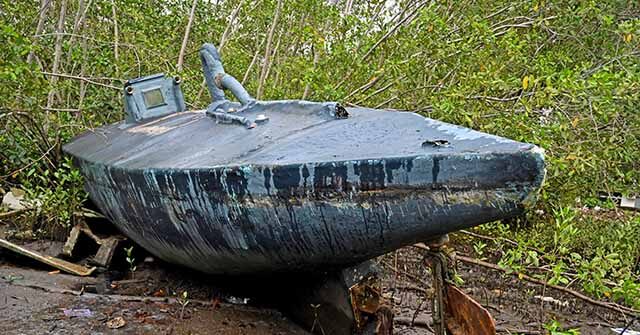
According to Vaz, some of the cartel’s products are shipped by traditional methods, including illicit loads on cargo ships and high-speed drug boats, but the “narco-subs” are a new threat. They are not true submarines, but rather cheaply made boats whose hulls are mostly hidden under the water. Only the top of the ship is exposed above the waves, and the cartels found it easy to paint the hull with colors that match the waves of the Atlantic Ocean.
Portugal managed to intercept a narco-sub in early November, with support from the UK National Crime Agency and the U.S. Drug Enforcement Administration (DEA), seizing over 1.7 metric tons of cocaine that was bound for the Iberian peninsula.
The ship had a crew of four, including two Ecuadorians, a Colombian, and a Venezuelan – a mix that told Portuguese police they were dealing with a multi-national cartel. The narco-sub was so shoddily constructed that it sank in the Atlantic after the crew and cargo were seized.
“Between the heat, the vessel’s fumes and high waves, with difficult weather conditions, even one day is tricky. By the end of 15 or 20 days all you want is to get out,” Portuguese drug enforcement official Vitor Ananias said of the hellish conditions endured by the crew.
The intercept in November was apparently made possible by a tip that told Portuguese authorities there was a narco-sub on the way. Sjoerd Top, director of the Maritime Analysis and Operations Center-Narcotics (MAOC-N), noted there have been “very few successful interceptions of semi-submersibles” and commended the Portuguese Navy for doing a “brilliant job.”
Portugal captured another narco-sub in March, along with its cargo of 6.5 tonnes of cocaine, but drug enforcement experts say most of the subs are getting through, bringing huge amounts of cocaine to Europe’s shores.
The UK Guardian noted in September that narco-subs were pioneered by Colombian cartels in the 1980s, but they were originally used for short hops across the Caribbean to Mexico and the United States. Trans-Atlantic narco subs are a new and fast-growing phenomenon, as the cartels grow either more ambitious to expand their reach to Europe, or more desperate to sell their product as access to the United States is cut off.
The first narco-sub was captured in the Atlantic in 2019 near the end of a journey from Brazil to the Iberian peninsula, a 27-day ordeal that narcotics police described as “insane” and a “nightmare’ for the crew.
The typical sub is incredibly claustrophobic, with only narrow windows to steer by, a tank of drinking water and a small freezer for supplies, and a portable air conditioner for comfort. Crews face a high risk of suffocation from the exhaust gases of their high-powered engines.
In March 2023, the Colombian navy discovered a narco-sub floating in the Pacific with two dead crew members, two survivors in “poor health,” and almost three tons of cocaine in the cargo hold. Colombian officials attributed the deaths and injuries to the inhalation of toxic fumes from the engine.
Brazil was the early hub for constructing and launching narco-subs, but Spanish journalist Javier Romero, a persistent chronicler of the sub industry, told the Guardian they are now being constructed and launched from many locations in Latin America, and the number of subs hitting the Atlantic has increased dramatically since the summer of 2025.
Romero said the narco-sub industry was as “exploitative” as the rest of the drug trade, with crews getting paid a pittance – often less than $5,000 – for undertaking a hellish ride in “propeller-driven coffins” to deliver cargoes worth hundreds of millions of dollars on the street.
“Just imagine spending hours, or days, stuck inside one of these things. It is total madness,” he said.
The new generation of narco-subs are more advanced than the pioneering ships built by the Colombian cartels, sometimes boasting depth sonar, long-range radio, anti-radar equipment, and water-cooled mufflers to mask their heat signatures. The hulls are more often made of fiberglass or metal than wood, and the improved hull designs have much smaller radar signatures.
In July 2025, the Colombian Navy seized a narco-sub that was operated remotely via a Starlink antenna. The ship had no cargo, leading security analysts to believe it was a trial run for unmanned submarines. The sea drone could have carried up to 1.5 tons of cocaine, if it had been loaded.
“Removing the crew eliminates the risk of captured operators cooperating with authorities,” noted U.S.-based investigator Henry Shuldiner.
Breitbart News
Read the full article .