

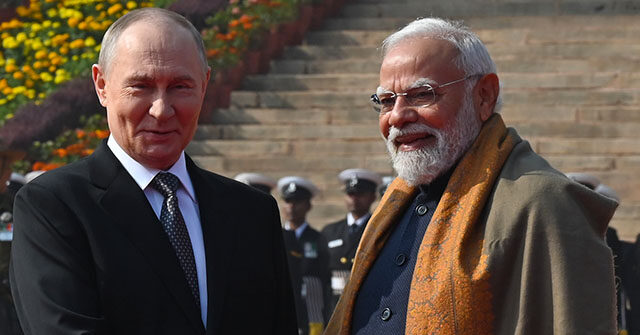
“Russia is a reliable supplier of oil, gas, coal – everything required for the development of India’s energy,” Putin boasted at his meeting with Modi.
“We are ready to continue uninterrupted shipments of fuel for the fast-growing Indian economy,” he promised.
President Donald Trump imposed a punitive tariff rate of 25 percent on India in August for buying Russian oil, piled atop the 25 percent general tariff rate for India.
Trump noted at the time that India has “always bought a vast majority of their military equipment from Russia, and are Russia’s largest buyer of energy, along with China, at a time when everyone wants Russia to stop the killing in Ukraine.”
In October, Trump announced sanctions against Russia’s two largest oil companies, Rosneft and Lukoil. The sanctions included penalties for third parties who did business with either company. The Russian companies were forced to sell off some of their overseas assets as a result, and Russian oil revenue fell by over $13 billion between October and November.
Modi’s government has always insisted it had the right to buy oil from any supplier and criticized the U.S. for penalizing India while giving Europe a pass for buying Russian energy products. Putin made a similar argument when he arrived in New Delhi on Thursday by criticizing the United States for continuing to purchase Russian uranium.
Despite the defiant rhetoric from both India and Russia, India’s purchases of Russian oil have sharply declined under Trump’s tariff and sanctions pressure. India’s crude oil imports are projected to hit a three-year low in December.
Kremlin spokesman Dmitry Peskov hinted this week that the decline in Indian oil imports was “insignificant” in the long term, because it would only last for “a very brief period of time.” He hinted that Moscow was working on a method of subverting U.S. sanctions that would enable India to resume heavy oil purchases.
“We have deep experience in performing under the regime of these illegal sanctions. We have our own technologies in doing that. We will continue to make those technologies more sophisticated should this practice of sanctions continue,” Peskov threatened on Tuesday.
In an interview with Russian state media on Friday, Peskov praised India as a “great purchaser of Russian oil” that was “earning good money” by using discounted Russian products. He expressed confidence that India’s benefits from doing business with Russia would outweigh the costs of U.S. sanctions.
“It is necessary to take into account what is lost due to duties imposed, and what is gained as a result of continued purchases,” Peskov said. “If continuation of purchases is bringing you better money, why not continue?”
Putin told a Russian-Indian business forum on Friday that many other avenues of profitable trade exist between the two countries.
“The Russian delegation has come not only to talk about energy issues, not only to place orders and sign contracts for the supply of oil or gas. We want to develop multifaceted relations with India in various areas,” he said.
Putin said Prime Minister Modi has “stressed many times in our personal conversations that India has huge and growing opportunities in many areas, but they are still not being utilized to the extent we would like.”
One of those areas is fertilizer. The head of the Russian Association of Fertilizer Producers, Andrey Guryev, said on Friday that Russia will have delivered up to 5.5 million tons of product to India by the end of 2025, capturing about 26 percent of the Indian import market.
“We will undoubtedly retain our leading position among importers of mineral fertilizers to India,” Guryev added, alluding to India’s heavy imports of Russian phosphorus.
Putin and Modi issued a joint statement on Friday that said Russia has agreed to “joint manufacturing in India of spare parts, components, aggregates, and other products for maintenance of Russian origin arms and defense equipment.”
The statement said Russia would transfer the necessary defense technology to India and would establish “joint ventures for meeting the needs of the Indian Armed Forces as well as subsequent export to mutually friendly third countries.”
This would be an unwelcome development for those concerned with the proliferation of Russian weapons across the world, and also for American and European leaders who hoped to break India’s dependence on Russia for military hardware.
Modi on Friday thanked Putin for Russia’s “unwavering commitment toward India,” especially in the realm of energy security, which he called a “strong and important pillar” of the bilateral relationship.
Modi said he would thank Russia for its oil supply and military support by establishing 30-day visa-free travel for Russian tourist groups.
“The world has witnessed many ups and downs in the last eight decades,” Modi said. “However, the friendship between India and Russia has remained like a pole star. This relationship is built on mutual respect and trust.”
Modi brushed against the awkward detail of Putin’s long and brutal invasion of Ukraine, insisting that India has “advocated for peace on the Ukraine issue from the very beginning,” despite its refusal to stop financing the war by purchasing gigantic amounts of Russian oil.
“We welcome all efforts being made for a peaceful and lasting resolution of this matter,” he said, alluding to President Trump’s peace initiative.
Modi suggested Russia’s threat to global stability by invading Ukraine was balanced by Russia’s partnership with India in “the fight against terrorism.”
“Whether it is the terrorist attack in Pahalgam or the cowardly attack on the Crocus City Hall, the root of all these incidents is the same,” he said.
Pahalgam is the city in Kashmir where a gang of terrorist gunmen massacred Indian tourists in April. The attack brought India to the brink of war with Pakistan, which India blamed for harboring the terrorists, or possibly even orchestrating the massacre. Crocus City Hall was the venue for a concert in Moscow that was attacked by Islamic State gunmen in March, killing 149 people and wounding over 600.
Breitbart News
Read the full article .