

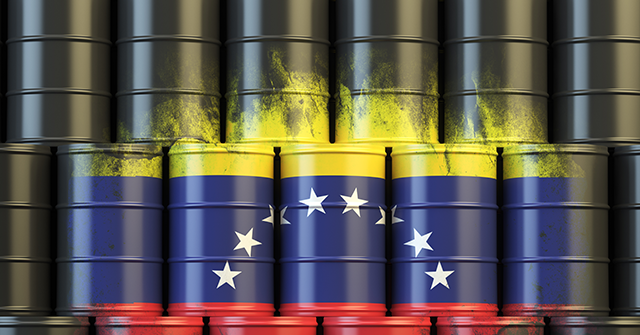
The operation to remove Nicolás Maduro may prove more economically significant than most commentary suggests. It may not lower oil prices any time soon, but over time it could reduce the supply shocks that do real damage to the U.S. economy.
Begin with the fact that tends to vanish in the “bonanza” chatter: there is no oil shortage right now. The U.S. national average for regular gasoline is $2.82 a gallon, according to AAA. Brent is around $61.15 a barrel. By recent standards, that’s already a world of cheap fuel. It’s also a reminder that anyone selling Venezuela as an instant price-cutter is marketing, not analysis.
But contrary to President Trump’s critiques, that doesn’t make Venezuela economically irrelevant. It means the economics run through a different channel.
How the Oil Shock Tax Works
A rise in the price of oil doesn’t do its macro damage in a gentle, linear fashion. The U.S. economy can live with ordinary price fluctuations. It gets hurt in the tail events—when a disruption hits and prices sprint higher because demand doesn’t politely adjust in the short run. People still drive to work. Trucking still moves goods. Airlines still fly. The price shock lands immediately in headline inflation and quickly becomes a policy problem.
That is where the real vulnerability lies: volatility and the sudden spikes that shove policymakers into the worst choice in economics. Either the Federal Reserve looks through the inflation jolt and risks unanchoring expectations, or it tightens to defend credibility and risks tightening into a slowdown. The 1970s taught us what happens when the Fed gets that choice wrong: an extended stagflation with unemployment above 10 percent. The early 1980s taught us what it costs to get it right: a brutal recession to break the cycle. Since then the episodes have been milder, but the pattern remains: shocks push headline inflation up, and the Fed ends up tighter than it otherwise would have been.
Seen through that lens, the Venezuela question isn’t how many barrels it can extract this year, next year, or over the next five years. It’s not even about how much oil is buried under its soil and sea. On paper, Venezuela is a world champion in reserves. The question is whether it can become a credible, investable source of supply—one the market believes will exist, expand, and be dependable under enforceable contracts.
That belief matters because it changes how risk is priced. Spare capacity is murkier than it used to be. Shale responds, but not on the timetable of a crisis. OPEC+ can manage barrels, but it also manages members. The result is a market that prices every tremor as if it might be the one that sticks. A market that believes supply can expand reacts differently. Panic becomes less likely when investors can imagine a real response, a real increase supplied from the Western Hemisphere to offset what happens in Russia or the Persian Gulf.
What’s more, the geographic distance between the Persian Gulf and Venezuela reduces the impact of regional shocks. If something goes awry in the Middle East, it is helpful to have vast reserves of accessible petroleum on this side of the globe. Already, production in the U.S. and Canada has made oil prices less vulnerable to Iranian belligerence. A stable, U.S. friendly Venezuela will push energy security even further.
None of this requires pretending Venezuela is a turnkey Saudi Arabia. The most responsible versions of the Venezuela thesis start with why it’s hard. Much of Venezuela’s crude is heavy. It needs upgrading of the infrastructure that has been allowed to decay. It needs capital measured in tens of billions. Above all, it needs institutions that don’t treat private investment as a temporary convenience to be punished later. Eventually, the generals and the communists probably need to go. In the short term, the economy of Venezuela will likely depend on whether the generals are willing to accept the new reality of the Donroe Doctrine.
That institutional piece is also the time piece. Even in a “successful” reset, Venezuela is not likely to add millions of barrels a day overnight. The more plausible scenario looks like a gradual production recovery measured in the low hundreds of thousands of barrels per day per year. That is meaningful over time, but it is not the stuff of immediate price collapses.
Meanwhile, the near-term price story can even run the “wrong” way. One under-appreciated possibility is that a U.S. move in Venezuela triggers defensive behavior elsewhere—especially in China, which has every incentive to treat geopolitical disruption as a reason to add to strategic petroleum reserves. A stockpiling impulse can support near-dated crude prices even when the market is otherwise well supplied. That’s the world we live in now: plenty of oil in aggregate, but a constant bid for insurance when geopolitics intrudes.
Notice what that implies. If China’s reaction is to hoard, it reinforces the underlying diagnosis. Beijing is buying insurance for the same reason the market embeds a fear premium: the current supply structure is brittle. When a real disruption hits—a Middle East flare-up, a sudden OPEC cut, a sanctions escalation—there aren’t enough credible swing producers to calm the market. Chinese stockpiling is a symptom of the fragility Venezuela could eventually help cure. The market doesn’t need Venezuela to flood the world with crude. It needs Venezuela to become credible enough that, in the next crisis, the question isn’t “how high can oil go,” but “how fast can supply respond.”
Price Stability Is Even Good for U.S. Production
There is also a temptation—especially from American producers—to treat any supply expansion abroad as an unalloyed negative because lower prices pinch margins. That’s a narrow, sectoral, short-term view. At the center of the U.S. economy are households whose real incomes are eroded at the pump, businesses whose costs jump unpredictably, and a central bank that spends its life trying to keep a few months of inflation from becoming a self-fulfilling psychology. Oil shocks hit the broader economy first. Even producers should prefer a world where capital can be planned. Boom-bust pricing invites overinvestment at the top and liquidations at the bottom. Volatility is the hidden tax.
Talk of “cheap oil” misses the point. We’ve got cheap oil now, largely thanks to the policies of President Trump and the rejection by the American people of the anti-fossil fuel fanaticism of the Democratic Party. The deeper upside is fewer episodes where an external supply disruption becomes an inflation spike, a confidence shock, and then a recession—exactly the sort of collision that turns a manageable slowdown into something uglier.
Think of a revived Venezuela as seatbelts or even a set of airbags. You don’t buy them to improve the ride. You buy them because collisions happen—and when they do, boring preparation is the difference between a scare and a catastrophe. A Venezuelan oil sector that can attract capital, protect contracts, and add supply on credible timelines is that kind of boring protection, reducing the odds that the next geopolitical tremor becomes an inflationary event and a recessionary policy response.
We want Venezuela to serve as a buffer stock for global oil supplies. Removing Maduro was the first step in realizing that plan.
Breitbart News
Read the full article .