

A Gallup survey released in August showed 54 percent of Americans report drinking alcohol this year, which is notable, given that the rate has only been under 60 percent fewer than ten times since the pollster began surveying on the issue in 1939.
Out of all ages groups, adults ages 18 to 34 report drinking the least at 50 percent, compared to 56 percent of people ages 35 to 54 and 56 percent of people 55 years old and up. Young adults are also more likely to perceive alcohol as bad for one’s health.
“In 2001, about 30 percent of young adults and middle-aged adults saw moderate drinking as harmful, while 21 percent of older adults agreed. However, by 2007, 18- to 34-year-olds had pulled ahead of both other age groups in their concern, including a recent surge to about two-thirds saying moderate drinking is harmful. Middle-aged and older adults’ belief that drinking is bad for health has picked up over the past few readings but still lags young adults’” assessed Lydia Saad, Gallup’s director of U.S. Social Research.
The data show a striking political difference as well: Republicans who report drinking alcohol has decreased a whopping 19 points since 2023, from 65 percent to 46 percent. Independents and Democrats have also reported drinking less in that same time frame, but not to such an extreme degree (61 percent to 55 percent for independents and 64 percent to 61 percent for Democrats).
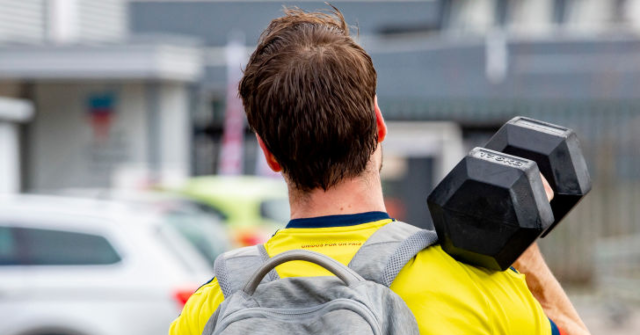
Trading Beers for Barbells
From a chain-reaction standpoint, the drop in alcohol consumption comes after the booze-fueled pandemic years, where Americans subjected to government-mandated isolation braved the toilet paper ration lines at Costco with the promise of Kirkland’s vodka in bulk. The data reflect the tragic reality of this time: alcohol-related deaths exploded. More data shows skyrocketing illnesses catalyzed by excessive alcohol consumption in the last 20 years.
The online wellness world, which includes the “manosphere,” has answered the call of booze crisis.
One pinnacle moment can be traced to a Huberman Lab podcast episode in 2022 called “Alcohol & Your Health,” from Stanford Professor of Neurobiology & Ophthalmology Andrew Huberman. To date, the episode as more than 7.7 million views, has inspired endless reaction content, and is the subject of Reddit threads with hundreds, if not thousands of comments of individuals saying they gave up the sauce after listening to the episode and hearing how alcohol destroys them from the inside out.
In a culture dominated by hedonism, emotion, and moral relativism, traditional values, logic, masculinity, and self-control have become counter-cultural and even revolutionary. Armed with the knowledge that alcohol in any quantity is toxic to the body and has killed hundreds of thousands of people in recent years, online personalities, particularly those who speak to struggling young men searching for purpose, have crusaded against inebriation and in favor of fitness.
Jordan Peterson, Joe Rogan, and Chris Williamson are a few examples of men with massive followings who advise young men to reject alcohol in favor of more disciplined lives. Charlie Kirk, a devout Christian and conservative firebrand who was assassinated in September at the age of 31, was a strong advocate of sobriety, exercise, and building a family.
President Donald Trump himself is a teetotaler, as is his Department of Health and Human Services (HHS) Secretary Robert F. Kennedy Jr. Both men made the rounds on these kinds of podcast shows before the 2024 presidential election — an election in which young men made a stark shift rightward. President Trump has recalled doing these interviews at the urging of a young Barron Trump, who viewed the appearances as an opportunity to appeal to disaffected young men.
One particularly striking moment was President Trump’s frank conversation with comedian Theo Von about addiction in which Trump talked about his reasons for sobriety, including losing his older brother Fred to alcohol abuse.
A rejection of alcohol can be seen in the broader Make America Health Again (MAHA) coalition that was also pivotal to President Trump’s 2024 victory.
The new health-conscious initiatives of the right brought in many people who were previously outside the conservative tent, like RFK Jr., but who are frustrated with food quality, chronic illnesses, and the lack of transparency around vaccines and the pharmaceutical industry.
But outside of the “manosphere” and MAHA, politically neutral fitness content that proliferates social media is filled with influencers and body builders who warn that alcohol “kills gains,” or stymies muscle growth.
Fitness-minded men and women who spend a lot of time lifting weights and pounding protein are revolting at the idea that all of their hard work can be undone or stalled in just a few sips.
Considering research emphasizing the importance of muscle as one ages, alcohol is now being seen as not only causing mad “hangxiety” in its immediate aftermath, but as also reducing quality of life with time. It is also being increasingly linked to cancer and neurodegenerative diseases.
Wellness clubs are a growing trend, especially among young people. They can be anything from a few friends doing sauna and cold plunge before grabbing a latte made with organic, shade-grown beans, to larger community meetups.
The Club Palm Beach is a prime example of a “social wellness club” with pop-ups around Florida that aims to “inspire a healthier, more connected community by making fitness fun and building real connections.” This author attended one such event in Jupiter, Florida, which drew hundreds of young people and featured fitness vendors, cold plunges, puppies, and even an exercise class led by “The Bachelorette’s” Tyler Cameron. The event took place at a bar, funnily enough, but drinking was optional and definitely not the main event.
In February, Vogue aptly called wellness clubs “Gen Z’s Country Club.” Forbes similarly called them “the new status symbol,” and remarked that the rise in people exercising together is in direct reaction to the physical isolation of the pandemic.
“Humans need humans for mental health… what happened through the [Covid-19] pandemic was we started correlating isolation with physical health, and there’s a huge problem right now that people are more isolated and feel lonelier than ever before,” Dr. Jonathan Leary, founder and CEO of Remedy Place, told the outlet.
Mocktails, Not Martinis
All of the above factors considered, the bar scene is anything but a ghost town with tumbleweeds.
Through real-life observation, the craft cocktail scene appears to be booming — along with craft coffees and craft beers. Young people (including this older Generation Z author) love novelty in flavors and decor, a place worthy of posting on social media, and a setting that provides a “third place” for a tech-steeped generation that has been deemed chronically lonely. Leo Daunt, the owner of The Bird in Montauk, New York, echoed this observation in a comment to Food Republic, noting that Gen Z is “invested heavily in finding unique experiences or tastes,” and that “the investment is really in a holistic [storytelling].”
Many who do not drink still like to go out and socialize: enter mocktails. The term “mocktail” has skyrocketed in Google Trends over the last 20 years, and the trade publication Nation’s Restaurant Reviews (NRN) notes that mentions of mocktails on menus are up 37.4 percent since 2019, including a 9.6 percent jump in 2024.
Every upscale bar or restaurant this author has been to in the last year, spanning from Florida to Phoenix, has had non-alcoholic options. These mocktails are often not just overpriced mixes of juice and soda. Instead, they are served like any alcohol-laden cocktail, sans booze, with infused syrups, elaborate garnishes, and poured sumptuously into decorative glassware.
“Mocktails have had a dramatic increase in popularity over the last year, and it’s a trend we continue to see grow,” said Steven Marshall, lead bartender of Dirty Habit at Hotel Zelos in San Francisco told NRN. “So many people have decided to forego alcohol for various different reasons, but still want to partake in the various celebrations, festivities, and experiences that bring people to the bar.”
Katherine Hamilton is a political reporter for Breitbart News. You can follow her on X @thekat_hamilton.
Breitbart News
Read the full article .