


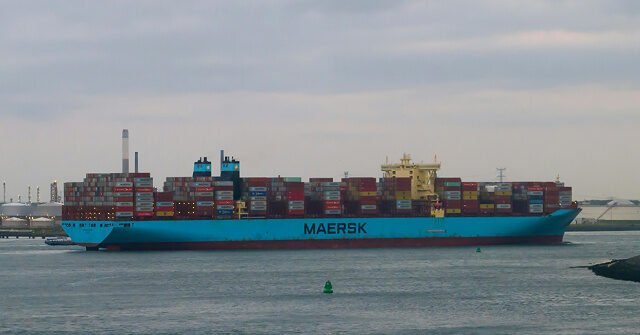
Maersk said it was too early to announce a full resumption of the route leading through the Suez Canal, but it would take a “stepwise approach towards gradually resuming navigation.”
“The first step is this initial sailing, followed by a limited number of additional trans-Suez sailings. However, there are no planned sailings currently,” Maersk said.
According to the Copenhagen-based company, the Singapore-flagged vessel Maersk Sebarok completed a transit of the Red Sea and Bab el-Mandeb Strait between Thursday and Friday.
Maersk Sebarok is an 18-year-old container ship that measures about 1,000 feet long, which makes it one of the smaller container ships in the Maersk fleet.
Reuters noted on Friday that a few other shipping lines have made recent passages through the Red Sea, but Maersk is so huge and influential that its resumption of the Red Sea route would have a seismic effect on the industry.
“By the end of 2026, we estimate things will start to look like they were before the Houthis attack started. The risk level has reduced, so they’re prepared to test the waters. But the Houthis aren’t particularly reliable,” container industry analyst Simon Heaney of Drewry Shipping Consultants told Reuters.
“The possibility of a return to Suez Canal routings looms large over the market outlook,” BIMCO chief shipping analyst Niels Rasmussen said on Thursday.
The Houthis began attacking civilian ships in the Red Sea in late 2023 to support Hamas during the Gaza War. Houthi officials often claimed they were targeting “Israeli” ships to punish Israel for bombing Gaza, but that was not the case.
Maersk and other big shipping companies, including Germany’s Hapag-Lloyd AG, began avoiding the Red Sea route in December 2023. Instead, they sailed around the southern tip of Africa, an alternate route that added thousands of miles, days of transit time, and enormous additional costs to shipping. Prior to the Houthi attacks, about ten percent of global maritime shipping passed through the Suez Canal.
The Gaza War ended, at least for the time being, with a ceasefire brokered by President Donald Trump in October. In early November, the Houthis signaled they would halt their attacks on Red Sea shipping. As Maersk’s careful test transit demonstrates, the shipping industry has been reluctant to take the Houthis at their word.
Shipping industry website FreightWaves made the interesting observation on Friday that diesel fuel prices have declined so much this year that the longer voyage around Africa might now be cheaper than sailing through the Suez Canal and paying its high tolls.
Breitbart News
Read the full article .