


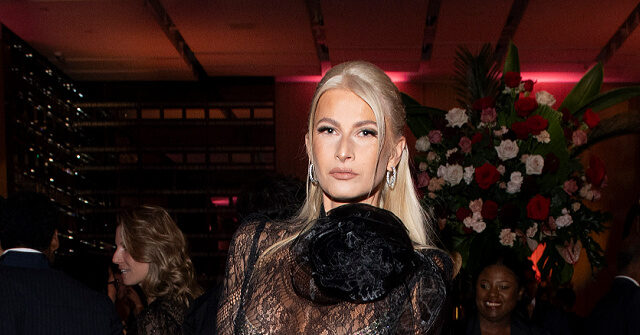
Speaking in recent days to Canadian, American, and Israeli media outlets, the 33-year-old Slovakian-Canadian model and Jewish activist described how a late-night ride home turned into a stark reminder of how quickly open hatred can surface — and how slowly a global corporation can respond when it does.
The incident occurred just after midnight on November 30 when a friend ordered her an Uber on Toronto’s Dundas Street so she could get home.
Once in the back seat, Mattova began a FaceTime call with another friend, speaking casually about a recent mission trip to Israel and her plans to return.
According to her account, the female driver — described as a Muslim woman — suddenly hit the brakes in the middle of a busy intersection and told her to get out.
Mattova said she initially thought there had been a technical issue with the ride.
“I asked her what was happening, and she said she did not feel comfortable with me in the car,” Mattova recalled. When she pressed for an explanation, she says the driver gave a blunt answer: they do not drive Jewish people.
“At that moment, I chose to step out of the car, not out of fear but out of clarity,” Mattova told the Jerusalem Post. “When someone reveals open discrimination, there is no reason to remain in that space.”
She ordered another Uber and went home. The next day, she filed a detailed complaint through the app. The friend who had booked the ride also submitted a report.
But Mattova says there was no meaningful response from Uber until the story appeared in the National Post. Only then, she says, did the company reach out.
“Uber responded with a phone call, saying that they are going to give me a refund,” Mattova told the Jerusalem Post. “I wanted to be clear that this situation is about more than the cost of a ride and that the incident I experienced was a blatant act of antisemitism.”
She said the call itself felt less like a hate-incident inquiry than a routine insurance script.
Her lawyer, prominent Toronto employment attorney Howard Levitt, said that when Uber finally spoke with his client, “they wanted to ask whether she had an injury from it, like an insurance company does. That is all they were interested in, not about the racism of the driver.”
Mattova said Uber later sent an email apologizing for her experience, promising to follow up with the driver “to try to ensure an incident like this does not occur again,” and refunding the fare.
A spokesperson told the National Post that “discrimination is unacceptable” on the platform and that the company had contacted the rider directly and taken “appropriate action” against the driver.
Uber has not said publicly what that “appropriate action” was and declined to confirm whether the driver is still active on the platform — a refusal that has become a focal point of Mattova’s case.
“What concerns me most is that Uber refuses to confirm whether the driver is still operating on the platform,” she said, adding that Uber cited the driver’s privacy rights. “Any responsible company, in my opinion, would immediately remove a driver who refuses to take someone because they are Jewish.”
Levitt argues that “privacy” is being used as a shield against accountability.
“We’ve demanded they terminate the relationship with the driver, and they’ve refused to respond to that at all,” he told Fox News Digital.
“They claim privacy, which is absolute nonsense. First of all, no one even knows the driver’s name, so there’s no privacy issue. And secondly, most decent companies are anxious to tell the world that they would fire someone like that.”
He says he has formally written to Uber demanding that it stipulate in every driver’s contract, on human rights grounds, that there can be no discrimination on the basis of religion or race, and that this is clearly flagged as grounds for removal from the platform.
Levitt confirmed that if Uber does not respond, he will file a human rights application with the Human Rights Tribunal of Ontario.
“The scourge of antisemitism has to be confronted by courageous individuals such as Miriam who are prepared to vigorously fight back,” Levitt told the National Post.
Mattova stressed that she is not seeking any payout for herself.
She has made clear that if Uber wants to put money on the table, she wants it donated to Israel Friends, an Israeli charity providing trauma care and other aid after Hamas’s October 7 attacks. In addition, she is demanding the driver’s dismissal and a formal apology to her — and to the broader Jewish community.
“This is not a one person’s problem,” she told the Jerusalem Post. “I think this is a bigger issue, and Uber has not been taking accountability for what’s been actually going on.”
Since she posted about the incident on Instagram, Mattova says, scores of people have reached out to her describing similar antisemitic incidents with rideshare drivers — episodes they say they reported to Uber, but that drew no real follow-up.
“When a company as large as Uber fails to respond, it sends a completely wrong message,” she said. “A serious incident involving hate should trigger immediate action within 24 hours. Anything less allows prejudice to just go unchecked.”
For Mattova, the November 30 ride cut much deeper than a humiliating few minutes in traffic.
The Slovakian-Canadian model — Miss Slovakia 2012 — has been outspoken against antisemitism since Hamas’s October 7, 2023, terror onslaught in southern Israel, where terrorists massacred some 1,200 people and took 251 hostages.
She has gone back and forth between Europe and Canada for years, but moved back to Canada full-time in April 2023. After October 7, she became increasingly involved in pro-Israel advocacy, arguing that Israel has the right to defend itself and using her platform to highlight Jewish security concerns.
Her advocacy has included recent trips to Israel with the nonprofit Israel Friends, which focuses on trauma care for survivors of the attacks and for soldiers dealing with post-traumatic stress. Mattova has visited the Western Wall, communities near Gaza, and Kibbutz Be’eri, one of the communities devastated on October 7.
On one trip, she met former hostage Ofir Engel, who was kidnapped along with his girlfriend’s father and later freed.
“This work connected me to families and survivors in a way I did not expect,” she told Israeli media. “Helping Israelis is my mission.”
That mission is rooted in family history.
Mattova’s 90-year-old Slovakian grandmother is a Holocaust survivor who was held in the Theresienstadt concentration camp. Only she and her mother returned.
“My family’s history significantly shapes my views,” Mattova told the Jerusalem Post. “My grandmother survived the concentration camp, which reminds me of the necessity to remember these events, like ensuring such hatred never reoccurs. We must remain vigilant against antisemitism and all forms of hatred. That’s exactly why I’m doing this. That’s my main reason.”
She says her grandmother long ago warned her about the “early signs” that appeared one or two years before the war — small acts of hostility that many dismissed at the time.
“These moments remind me of exactly what she was telling me,” Mattova said in another interview. “If we let these things slide, will the same thing repeat itself? That’s my biggest question: Where are we heading?”
In recent months, she has also been visible in domestic Canadian debates. When the Palestinian flag was raised at Toronto City Hall in November, Mattova attended with an Israeli flag, later arguing that “in Canada, the only flag that should be raised is the Canadian flag.”
Levitt frames what happened in the Uber as part of a broader shift in the country.
“Unfortunately, as we permit demonstrations to take over our streets, often focused on Jewish neighbourhoods, replete with criminal hate speech, terrorizing the Jewish community, antisemitism is increasingly normalized, allowing residents, such as this driver, to believe that such conduct will be tolerated,” he warned.
He added that “much of the Jewish community is fearful in Canada and is considering leaving to go to the US or Israel,” and charged that “mainstream organizations are not being sufficiently aggressive, preferring condemnation to concrete action.”
For her part, Mattova says this is not the first antisemitic incident she has experienced in Canada, and she is no longer sure she wants to stay.
“At this moment, I question if I do have a future in Canada,” she told the Jerusalem Post.
She has already said she is nervous to use rideshare apps at all and, for now, will rely on friends or other platforms. She is also openly considering relocating — possibly to Israel.
“Canada has always been a place I believed in … welcoming, diverse, respectful,” she told Fox News Digital. “We all share responsibility to ensure it stays that way. Speaking up isn’t about me playing a victim role. It’s about drawing a line and standing in our truth, and inspiring that hatred against any religion or community, not just the Jewish people, has consequences.”
For her, the night of November 30 is a warning as much as a personal insult.
“When a driver says something like this, it cannot be treated as a customer-service issue,” Mattova said. “It is discrimination, and it is dangerous. History shows where silence leads. That is why we cannot ignore it.”
Joshua Klein is a reporter for Breitbart News. Email him at jklein@breitbart.com. Follow him on Twitter @JoshuaKlein.
Breitbart News
Read the full article .