


The Federal Reserve enters its pre-meeting blackout period this week with markets pricing in an 89 percent chance of a rate cut at the December 9-10 Federal Open Market Committee (FOMC) meeting. Since Fed officials have done nothing to discourage this view, consider it confirmed. What happens after that, though, gets considerably more interesting—and potentially treacherous for the Trump administration.
After December’s expected cut, the fed funds futures market shows no appetite for further reductions until April, which would likely be Jerome Powell’s final meeting as Fed chairman. President Trump has announced he’ll name Powell’s successor early in the new year, and the betting markets have spoken: Kevin Hassett, currently head of the White House’s National Economic Council, is the clear favorite on Polymarket. Hassett would be an excellent choice—experienced, respected, and aligned with Trump’s growth agenda.
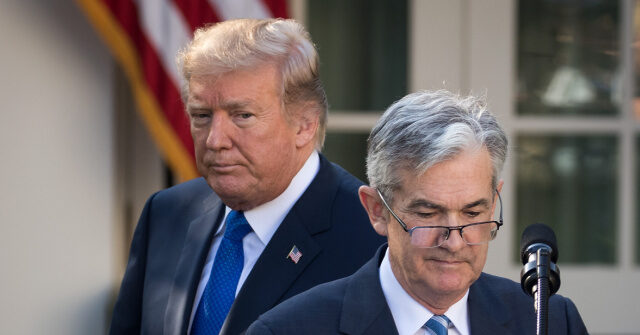
President Donald Trump looks on as his nominee for the chairman of the Federal Reserve Jerome Powell takes to the podium during a press event in the White House Rose Garden on November 2, 2017, in Washington, DC. (Drew Angerer/Getty Images)
What if the Stubborn Ox Stays on?
But here’s where the story takes a turn that should worry anyone thinking seriously about monetary policy for the next several years. Powell’s term as chairman expires in May 2026, but his term as a Fed governor runs through January 2028. While highly unusual—it’s happened only once in Fed history—nothing prevents Powell from relinquishing the chairmanship while retaining his seat on the Board of Governors. Asked repeatedly whether he plans to step down from the board when his chairmanship expires, Powell has declined to say. And given Trump’s recent description of Powell as a “stubborn ox who probably doesn’t like your president,” combined with the administration’s ongoing legal battle over the removal of Fed Governor Lisa Cook, one might reasonably wonder whether Powell views staying on as a matter of duty to “Fed independence.”
Picture it: Hassett arrives as the new chairman, and there sits Powell, still voting at every FOMC meeting, still commanding the respect and institutional loyalty of the permanent Fed bureaucracy, still capable of organizing resistance to any meaningful policy changes. Call him the Shadow King of monetary policy—deposed but not departed, leading what Nick Timiraos of the Wall Street Journal recently described as a deeply divided FOMC from his seat among the governors.
Administration officials privately dismiss this scenario as unlikely. They may be dangerously complacent.
The Miran Maneuver
There is, however, a pathway around this problem—but only one. Since the Fed chairman must be chosen from among the sitting governors, Trump needs an available governor seat to appoint an outsider like Hassett. If Powell stays on as governor and the Lisa Cook case drags on unresolved or the Supreme Court rules against the administration, there would be no vacancy for an outside candidate. Powell could effectively block Hassett’s appointment simply by refusing to leave.
The solution lies with Fed Governor Stephen Miran, who is currently on leave from his position as Council of Economic Advisers chair after being elevated to the Fed board when Adriana Kugler resigned unexpectedly amid trading allegations. Miran’s term expires January 31. If Trump appoints Hassett to that seat, Powell cannot block the appointment. Miran can hold the seat under the Fed’s statutory holdover provision until a successor is confirmed, giving the Senate time to act.
The timing of Trump’s announcement that he’ll name his pick in January suggests this is precisely the strategy. Nominate someone for the Miran seat in January, get them confirmed by spring, and elevate them to chair when Powell’s term expires in May. It’s elegant, it works, and it gets Trump his chosen chairman.
But it may not maximize Trump’s influence over monetary policy.
Hassett or Waller: A Question of Board Arithmetic
Consider the arithmetic. If Trump names an outsider like Hassett and Powell decides to stay on as governor, Trump gets exactly one “joint” appointment—Hassett as both governor and chair. He might get a second if the courts rule in his favor on the Lisa Cook removal. That’s it. One or two voices on a committee that Nick Timiraos reports is more divided than at any point in Powell’s nearly eight-year tenure.
Now consider the alternative: Trump names Fed Governor Christopher Waller as chairman. Waller is an insider, a monetary economist of genuine distinction, and his elevation would look like continuity rather than conquest. Powell, having preserved the appearance of Fed independence, might well step aside gracefully. In that scenario, Trump fills the chair position by elevation, appoints someone new to the Miran seat, appoints someone to Powell’s now-vacant governor seat, and possibly fills the Cook seat if litigation goes his way. That’s three to four appointments, enough to genuinely reshape Fed policy for years to come.
The Lisa Cook case remains the wild card. If Trump wins that constitutional battle over presidential removal powers, another seat opens up. But court calendars being what they are, that seat might not be available when it matters most for reshaping the committee.
The strategic choice, then, comes down to this: Does Trump want his preferred candidate in the chairman’s seat, or does he want to maximize his influence over monetary policy? The betting markets say Hassett. The board arithmetic says Waller might be smarter.
And somewhere in the Eccles Building, Jerome Powell is presumably calculating his own options. The man Trump calls a stubborn ox might prove stubborn enough to stick around, operating as a kind of monetary policy resistance leader for the next two years.
The Trump administration would be wise to game this out more carefully. The Shadow King scenario isn’t some far-fetched possibility. It may be probable. And preventing it might require some uncomfortable strategic choices in the weeks ahead.
Breitbart News
Read the full article .